POKE
FAME
Rare by design /
priced by the market
A vault of rare Pokémon cards, from Base Set holos to Gold Stars. Browse six curated tiers with dated market estimates, or choose every move in a Pokémon showdown.
Scroll to open the vault ↓Rayquaza
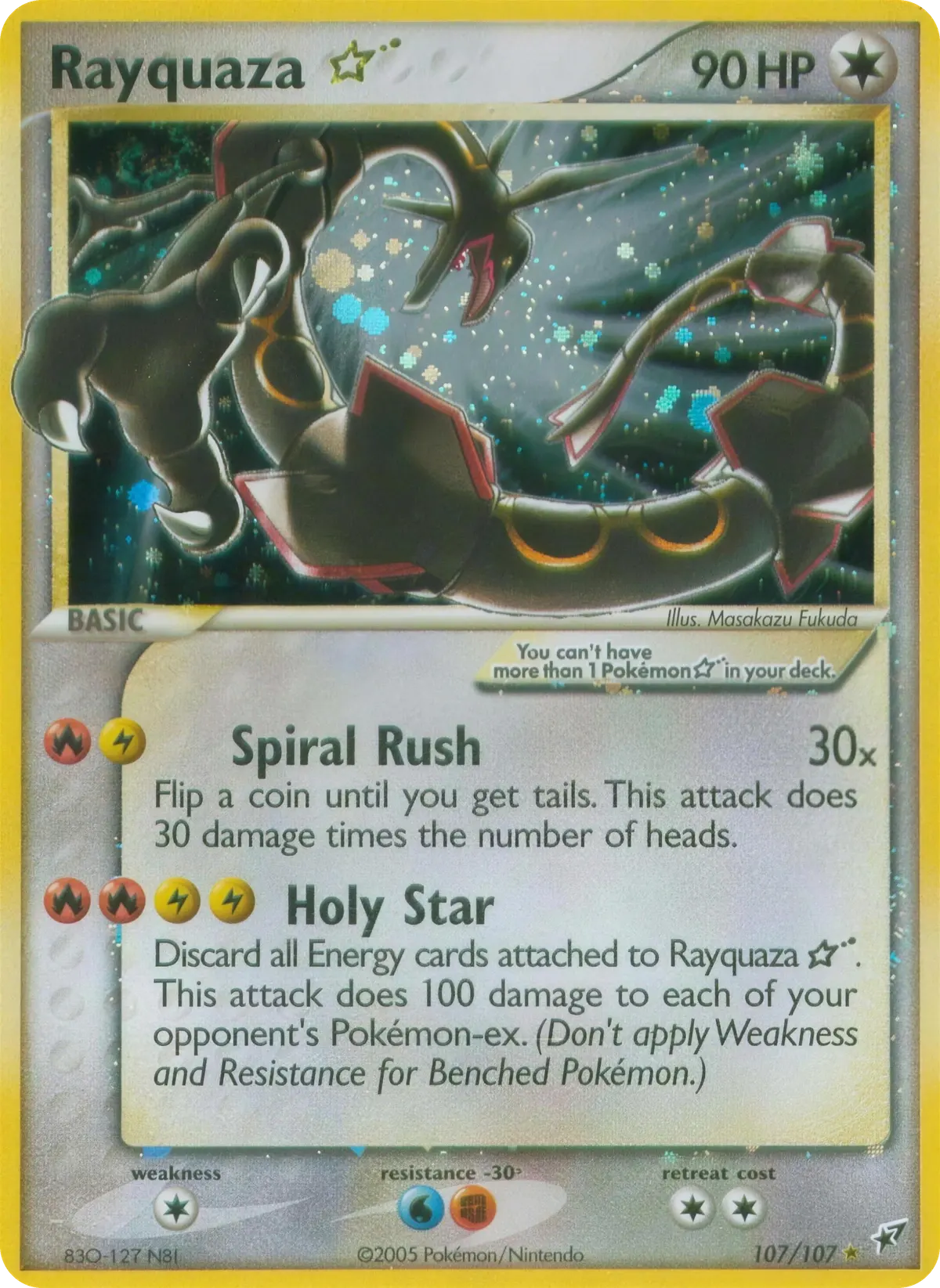

Gold Star /
one of the rarest
A shiny Rayquaza marked with a gold star, the rarest print in its set. Kept in tier 01 of the vault.
Scroll to turn the card ↓Explore Rayquaza ↗$2,501
Rayquaza
Shiny
Gold
Star$2,501
Choose
your
door.
The grail goes back in the vault. Follow it in, or take a team to the arena.
Pokémon cards.
A world to explore.
From the card you remember to the team you have yet to try. A field guide to collecting and playing with POKEFAME.
Pokémon cards, with the details in view
Every collection begins with something that catches your eye. It might be a familiar Pokémon, a striking illustration, or a card you remember pulling years ago. pokefame brings those discoveries into a visual card vault, alongside a browser battle tool for trying your favorite creatures in action. You can explore Pokémon cards, read about individual printings, and then build a team for a different kind of encounter. Start with whichever side of Pokémon you enjoy most.
The Pokémon card vault is a curated selection rather than a complete checklist of every release. Open a card to see its artwork, set, card number, recorded rarity, and available collector notes. Those details help distinguish cards that share a character but belong to different releases. Follow the dedicated card link when you want a page to bookmark or share. Looking closely at one printing is often more useful than comparing several cards by name alone.
What makes rare Pokémon cards worth a closer look?
Rare Pokémon cards can attract attention for different reasons: an unusual illustration, a distinctive treatment, a memorable set, or a Pokémon with a devoted following. The vault gives you room to inspect those differences. Its six editorial tiers run from common and uncommon through rare, holo, ultra, and grail. These are browsing groups chosen for this collection; each card’s catalog rarity is shown separately, so the two descriptions do not get confused.
The homepage spotlights Rayquaza from EX Deoxys, a starting point for exploring the collection’s Gold Star era. From there, compare vintage favorites with newer illustration cards and other featured releases. A grail is a personal collecting goal as much as a label. You might care most about one artist, one species, or completing a particular set. Use the artwork and notes to discover what interests you, instead of letting a tier decide your entire wishlist.
Read the card price, then read the context
A number becomes more useful when you know what it describes. Where pricing is available, pokefame shows a market estimate with its source, currency, variant, and update date. The card data comes through the Pokémon TCG API, with estimates sourced from TCGplayer or Cardmarket. Check that date before making comparisons: the displayed figure is a dated reference, not a live offer or a promise that a seller will accept that amount.
Compare the same printing and finish whenever possible. A raw card and a professionally graded copy are different comparisons, and the condition of an individual card cannot be established from catalog artwork. The vault’s estimates refer to raw, ungraded cards. For a copy you are considering, inspect the seller’s photos and description as well as the card identity. If a price is unavailable, the artwork and collector information still give you a useful place to begin your research.
A collection that follows your interests
Use the card controls to mark what you own and what you would like to find. A card can be both owned and wanted, which is useful when you are looking for another copy. These choices are saved in the browser you are using. They do not require an account, but they also do not automatically travel to another device. Clearing site storage can remove those saved marks.
A focused collection is easier to explore than an endless shopping list. Try following a favorite Pokémon across sets, comparing the work of an illustrator, or revisiting the artwork from a childhood release. Open the collector notes and check the printed identity before adding a card to your plans. pokefame is a reference and discovery tool, so browsing does not reserve a card or place an order. You can take your time and return to the details that matter to you.
Build your own Pokémon showdown
When you want to move from collecting to playing, open the Pokémon showdown battle tool. Search for Pokémon and add between one and six to each team. Choose supported moves, arrange the team order, and put your intended lead in the first slot. You can build the opposing team yourself or use its randomize control for a fresh matchup. Switch between HD artwork and classic sprites to choose the look you prefer.
This is pokefame’s own simplified, local battle simulator, separate from the Pokémon Showdown service. You control both teams in the same browser rather than joining an online matchmaking ladder. Select Fight, then choose an attack for the highlighted Pokémon. Each attack waits for your input, so you can pause to consider the available moves. When a Pokémon faints, the next member in its lineup enters; the last team with a Pokémon standing wins.
Learn a matchup, one move at a time
The battle tool makes a few core relationships easier to see. Speed helps determine move order, while offensive stats, defensive stats, and type matchups influence damage. Every Pokémon battles at level 50 with the same IV, EV, and nature settings. The move menus draw from the species’ recorded learnsets and include supported damaging attacks. Try a different lead or moveset and watch how the same two teams can create a different encounter.
The rules stay deliberately compact: held items, abilities, weather, and status effects are not simulated. Accuracy, critical hits, and damage rolls can still change a rematch. Use the experience to explore basic decisions rather than predict a full competitive ruleset. Whether you arrived for rare Pokémon cards or a quick Pokémon battle, the next step is simple: inspect a card that interests you, or choose a team and see what happens when your favorites meet.
Good questions.
Closer looks.
Pokémon card rarity, prices, and the tools in your collection. Start here.
What is the rarest Pokémon card?
There is no single ranking that covers print runs, surviving copies, and condition. Pikachu Illustrator is one of the best-known exceptionally rare cards: it was awarded through an illustration contest rather than sold in regular booster packs. A record auction price makes a particular copy the most expensive, but does not prove that its printing has the fewest copies.
Read the Pikachu Illustrator record and history at Guinness World Records.
What are some of the most rare Pokémon cards?
Examples include Pikachu Illustrator, early Japanese Pikachu trophy cards, and the 1998 Family Event Kangaskhan trophy card. These were special awards with limited distribution. They belong to a different collecting category from rare cards pulled from ordinary packs, and a numbered “top ten” changes depending on whether you compare distribution, known surviving copies, or sale prices.
Explore PSA’s guide to Pokémon trophy cards, or browse the rare Pokémon cards in our vault.
How do I tell if a Pokémon card is rare?
Start with the rarity symbol near the card number and match the card to its exact set and language. On many English cards, a circle means common, a diamond means uncommon, and a star means rare. Newer sets use additional symbols: for example, Scarlet & Violet introduced two black stars for double rare cards. Promos and other special releases can follow different conventions.
Compare the number, artwork, and finish with the set’s official checklist. A shiny surface alone does not establish rarity or value; reverse-holo versions can have the same rarity symbol as their non-holo counterparts.
See the official Scarlet & Violet rarity guide and an official card checklist with rarity symbols.
How much is the most expensive Pokémon card?
Guinness World Records reported a sale of US$16,492,000 for a PSA 10 Pikachu Illustrator on February 16, 2026. That total includes the auction buyer’s premium. It describes a particular graded copy and a dated sale, not a general price for every Illustrator card or other rare Pokémon cards.
Read the dated auction record. For everyday comparisons, check the printing, condition, currency, and date behind any estimate.
Does a rare Pokémon card always have a high value?
No. Catalog rarity and market value measure different things. Identify the exact printing and finish, then compare recent completed sales for copies in similar condition. A seller’s asking price is not proof that a card sold for that amount. New releases also need this same comparison; the year printed on a card is not enough to establish its value.
Our card pages show dated estimates where available, with the source and currency. They are references for raw, ungraded cards, not offers to buy or sell your copy.
Where can I buy rare Pokémon cards?
Individual cards are sold by card shops, specialist marketplaces, and auction houses. Compare seller history, buyer protection, return terms, and clear photos of the actual copy. For graded cards, check the certification with the grading company. Buying a sealed pack does not guarantee a particular rare card.
For official sealed products, Pokémon Support lists shopping options and a retail locator. pokefame is a reference tool; we do not sell cards or arrange transactions.
Is pokefame the same as Pokémon Showdown?
No. Our Pokémon showdown tool is an independent, simplified battle simulator. You build two teams and control both sides in the same browser. It has no online matchmaking ladder and does not simulate items, abilities, weather, or status effects. It is separate from the Pokémon Showdown service.